

















A lottery ticket holds a small collection of numbers and an enormous amount of possibility. Understanding that possibility starts with a distinction: a combination can feel special without being more likely to appear.
This is an educational demonstration article. It does not report a recent drawing, recommend a purchase, or describe a strategy for predicting the next result.
Five numbers, then two
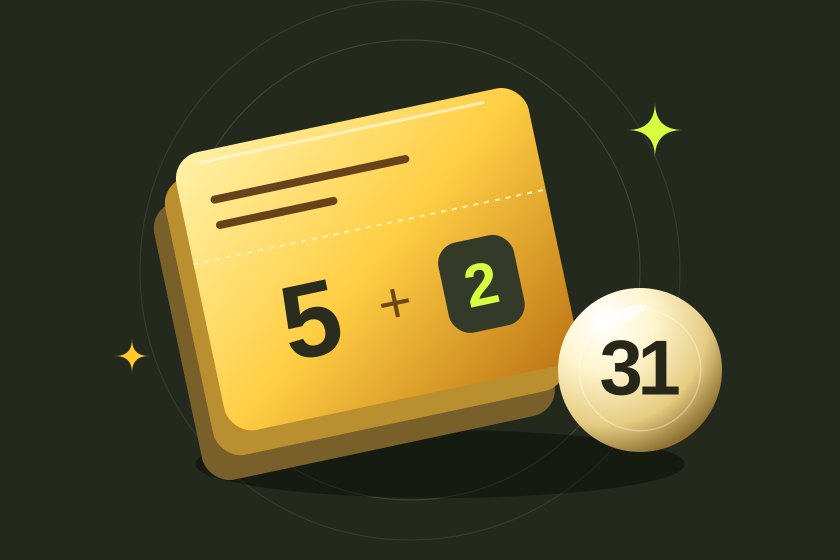
Under the 5-from-50 and 2-from-12 format, a line consists of five different main numbers and two different Euro numbers. Within each group, the order does not matter. Picking 7, 16, 24, 38 and 45 is the same main-number selection however you arrange it.
There are 2,118,760 ways to choose five numbers from 50. Separately, there are 66 ways to choose two from 12. Multiplying those counts gives 139,838,160 distinct complete combinations. Matching all seven numbers with one line therefore has a probability of 1 in 139,838,160 in a fair draw under this format. This is the jackpot probability, not the probability of receiving any prize.
The calculation uses combinations: C(50, 5) × C(12, 2). A useful way to understand the first factor is to count every ordered choice and then divide by the 120 ways the same five numbers could be rearranged. The second factor divides the ordered choices of two Euro numbers by two.
Why ordinary-looking numbers are no better
The sequence 1, 2, 3, 4, 5 can look suspiciously neat. A scattered line can look more random. Yet each particular valid line represents exactly one outcome in the same set of 139,838,160 possibilities.
A broad category such as “a mix of high and low numbers” may contain many outcomes. A particular line within that category is still only one outcome. Confusing a category with an individual combination is one reason that intuitive assessments of lottery probability can go astray.
A line can be personally meaningful without having a mathematical advantage.
What more lines change
Choosing two distinct complete lines covers two possible jackpot outcomes instead of one. The probability is then 2 in 139,838,160 for that draw. It remains very small, and buying additional lines also means spending more. Repeating the same line does not cover an additional possible outcome.
This arithmetic is not a spending recommendation. A budget is a limit on what you can afford to lose, not a target to reach. A lottery is not a substitute for savings, income or a financial plan.
Where AI fits
Software can check that numbers are valid, put them in order, summarize a dataset and explain a selection. None of those tasks establishes an ability to forecast an independent fair drawing.
The combinations in this frontend preview are hand-authored fixtures. They demonstrate how a future selection system would be presented. No model has analyzed historical draws for this preview, and the word “AI” in the product name should not be read as evidence of a predictive advantage.
Read the right probability
When comparing claims, ask which event a probability refers to: matching the jackpot, matching a lower prize tier, or receiving any prize at all. These are different events. Prize values and participation rules also require current official information from the operator for your jurisdiction.
The official statistics page linked below describes the number pools and jackpot odds. Always check current operator rules before relying on a game description. For this project, the important lesson is simpler: understanding a number is useful even when it cannot tell you what comes next.
Sources & further reading
Original educational text. Published as demonstration content, with no live results or connected historical dataset.